Ask most people what personal transformation looks like and they will describe a dramatic moment: a crisis, a breakdown, a sudden bolt of clarity that rewires everything overnight. But real transformation rarely works that way. More often it is slow, unglamorous, and almost invisible at first — and then one day you realize you are no longer the person you used to be.
That is good news. It means transformation is not reserved for people who hit rock bottom or receive a mystical calling. It is available to anyone willing to do the quiet, consistent work of becoming.
What personal transformation actually is
Transformation is not the same as change. Change is external — a new job, a new city, a new relationship. Transformation is internal: a shift in who you believe you are and what you believe is possible. External changes that are not supported by internal shifts rarely last. Internal shifts almost always reshape the external world in time.
Think of it as identity work. You are not trying to add a new habit to an old self; you are slowly becoming someone for whom the new way of living is simply natural.
Why we resist transformation
We often think we are afraid of the unknown. In truth, we are usually afraid of losing the familiar — even when the familiar is painful. Our identities are built from stories we have told ourselves for years: I am the kind of person who…, this is just how my life goes. Letting go of those stories can feel like letting go of a part of ourselves. The article on the art of letting go explores why release is so hard and so necessary.
Comfort is not the only obstacle. Fear of judgment, fear of failure, and the sheer exhaustion of change all play a part. Naming these obstacles is the first step past them.
The three phases of transformation
Almost every meaningful transformation follows a similar arc:
- Ending and release. Something has to give — a habit, a story, a situation, a version of yourself. This phase is often the hardest because it involves loss before gain. If you are there right now, the essay on the beauty of starting again was written for you.
- The in-between. The old identity is gone, and the new one has not fully formed. This liminal space is uncomfortable, but it is also where the real growth happens. Resist the urge to fill it with noise; stay present with it.
- Integration. New insights become new habits. New habits become a new identity. You begin to make choices that would have seemed impossible a year earlier — almost without effort.
Most people abandon transformation in phase two, precisely because it feels like nothing is happening. But the in-between is not emptiness. It is incubation.
Small practices, big identity shifts
You do not change your life in one heroic act. You change it in a thousand small, repeatable ones:
- Act as if, one step at a time. Ask yourself what the person you want to become would do today, and do that one small thing.
- Redesign your environment. Make the new behavior easier than the old one. Remove friction from what you want to do and add friction to what you want to stop.
- Track progress, not perfection. A two-minute streak of showing up counts. Momentum matters more than intensity.
- Tell a new story about yourself. Replace “I always quit” with “I am learning to follow through.” The words you use about yourself become the identity you live into.
- Build in rest. Transformation is demanding. Balance in a busy world is not a luxury — it is the container that holds change.
When transformation requires real courage
Some transformations cannot be done gently. Occasionally life — or a quiet inner calling — asks you to leave behind something substantial: a career, a place, a relationship, a story you have told for decades. This is where transformation stops being a self-help exercise and becomes an act of courage.
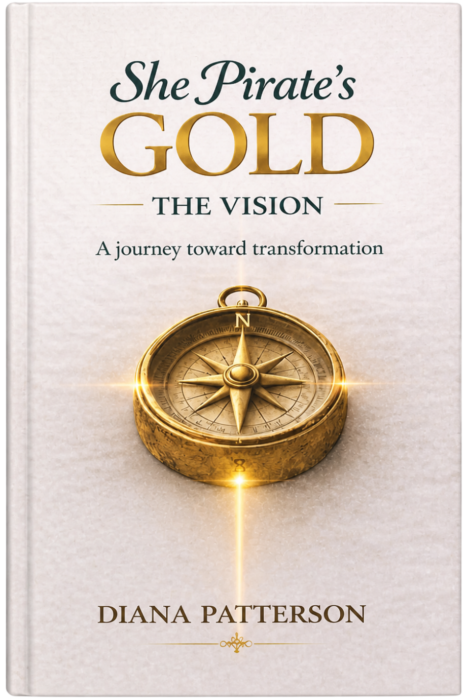
Diana Patterson knows this territory. At the lowest point of her life, she experienced a vision that would not release her, and she chose to trust it — leaving everything familiar behind to follow an inner compass she could not yet explain. The journey took her across the Caribbean through storms and shipwrecks, and it became the subject of her memoir, She Pirate’s GOLD – The Vision. You can read the fuller account in the true story behind the book.
You do not need a vision to begin. But you may need the same willingness she found: the willingness to trust that the life you are leaving behind is smaller than the life you are walking toward.
Five steps to start today
- Write one sentence describing the person you want to become in five years.
- Identify the single belief that most keeps you from being that person.
- Choose one small action that contradicts that belief, and do it this week.
- Remove one thing from your environment that props up the old story.
- Tell one trusted person what you are becoming, so you are no longer doing it alone.
Transformation is not a destination you arrive at once. It is a direction you choose daily. Choose it today, in something small, and let the small things compound.
Related reading: walking through uncertainty and how to build resilience when life gets hard.