Intuition is one of those words everyone uses and almost no one can pin down. It is the quiet knowing that arrives before you can explain it, the pull toward a decision you cannot fully justify, the subtle sense that something is right or wrong long before the evidence arrives.
For many of us, that inner voice gets drowned out. We are taught to value logic, data, and careful planning, and to be suspicious of anything that cannot be measured. But intuition is not the opposite of thinking. It is a different kind of intelligence, and learning to hear it can change the direction of your life.
What intuition actually is
Think of intuition as the mind’s rapid, below-the-surface processing. Your brain is taking in far more information than you consciously notice: body language, patterns, tone of voice, memories that feel similar to the present moment. Sometimes that processing surfaces as a hunch rather than a reasoned argument.
Many people also describe intuition as something deeper than pattern recognition — an inner guidance, a still small voice, a sense of being led. You do not have to choose between these explanations. Both point to the same practical truth: you have access to knowledge that your conscious, analytical mind has not yet organized, and you can learn to listen to it.
Intuition vs. fear: learning to tell them apart
The most common reason people ignore their intuition is that it feels too similar to fear. But they are not the same, and the difference matters:
- Fear is loud and repetitive. It loops, catastrophizes, and focuses on worst-case scenarios. Intuition is usually calm and single — it states something once and waits.
- Fear contracts. It makes you feel smaller and more stuck. Intuition, even when it asks you to do something difficult, tends to feel quietly expansive — like a door opening rather than a wall rising.
- Fear needs reassurance. It keeps asking “what if?” Intuition has a quality of settledness, even when the outcome is uncertain.
- Fear is about avoiding. Intuition is about aligning — with your values, your health, your deeper sense of who you are.
A useful test: if the feeling grows quieter when you stop trying to control the outcome, it was probably fear. If it remains steady and clear, it is probably intuition.
Five ways intuition shows up
Intuition rarely arrives as a booming voice. It tends to speak in quieter languages:
- A physical response. Tightness in your chest, a knot in your stomach, or a sense of relief when you imagine saying “yes” or “no.”
- Sudden clarity. The answer that appears fully formed while you are in the shower or on a walk — after you stopped forcing it.
- Repeated nudges. The same thought, name, or idea returning again and again until you finally pay attention.
- A sense of “off.” Feeling uneasy about a person or situation even though everything looks fine on paper.
- Knowing without knowing how. Being certain about something before you have the information to justify it.
None of these are proof by themselves. But when several of them point in the same direction, it is worth treating the signal seriously.
How to strengthen your intuition
Intuition is like a muscle: it strengthens with use and attention.
- Create quiet. Intuition cannot compete with constant input. A few minutes of stillness each day — no phone, no noise — gives the quiet voice room to be heard. Our article on the quiet strength of stillness explains why silence is such a powerful teacher.
- Practice on small decisions. Ask yourself what feels right about lunch, a route home, or an email you are hesitating to send — then notice what your body and mind say before you analyze it.
- Journal. Writing slows your thinking down enough to separate your own voice from the noise. Notice which entries felt true the next day.
- Pay attention to your body. Your physical reactions are data. Start naming them: “my shoulders are tight about this” or “I feel lighter when I imagine that.”
- Cut the noise. The more information you consume, the harder it is to hear yourself. Regular digital breaks make intuition more audible.
When to trust intuition — and when to check the facts
Trusting intuition does not mean abandoning reason. The wisest approach is cooperative: let intuition point you in a direction, then use logic, research, and good counsel to test the path before you commit to it. Use intuition for the big “which way?” questions and reason for the “how do I get there?” questions.
And when intuition asks you to do something genuinely frightening but aligned with who you want to become, that is exactly when it deserves your attention most.
A story of a vision trusted
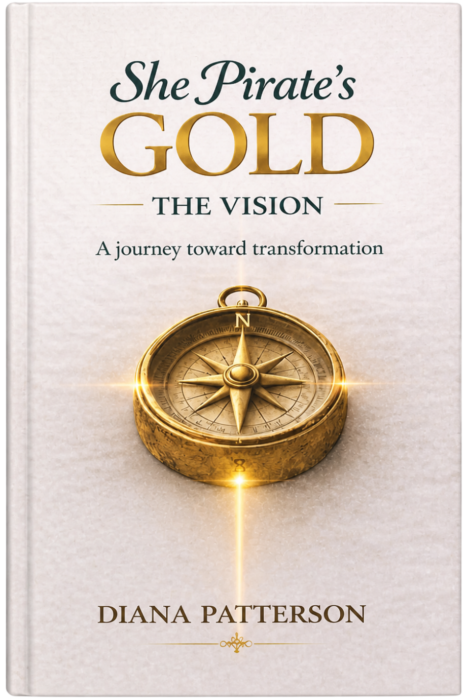
Intuition does not only handle everyday choices. Sometimes it arrives as a single, life-changing moment. That is what happened to author Diana Patterson. At the lowest point of her life, she experienced a vision so vivid it would not let her go — and with no map, no certainty, and no explanation she could give anyone, she chose to trust it.
That decision launched a real-life adventure across the Caribbean, through storms, sailboat deliveries, and shipwreck diving, and into the discovery of Mel Fisher’s legendary Spanish galleon, the Nuestra Señora de Atocha. Beneath the search for gold lay a greater discovery: that intuition may be one of the ways we are quietly guided toward the life we were meant to live.
You can read that full journey in the story behind She Pirate’s GOLD and in her memoir, She Pirate’s GOLD – The Vision.
Journal prompts to hear your own voice
- What decision have I been avoiding, and what does my body say when I imagine each option?
- When in my life did I ignore a hunch, and what did I learn?
- When did I trust an inner knowing and it turned out to be right?
- If I were not afraid, what would I do next?
Intuition is not magic, and it is not infallible. It is simply a deeper channel of knowing that most of us have neglected. Start listening — in small ways, in quiet moments — and you may find that the clues were there all along, waiting for you to follow them.
If you are learning to listen to your inner voice, you may also enjoy six signs your intuition is trying to tell you something and our guide to living one moment at a time.